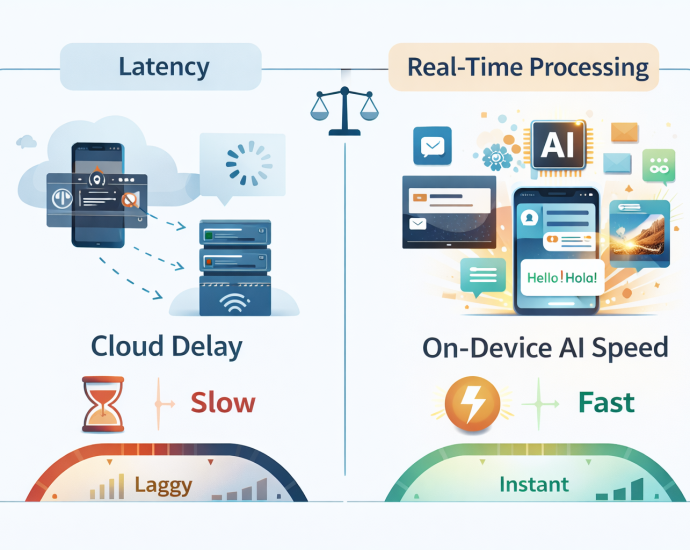
Latency Issues and Frustrated Users: Delivering Real-Time Performance with Offline On-Device Generative AI
A prominent sector specialist faced declining user retention due to significant latency in their mobile service applications. To address this, we deployed a Custom Tiny AI Model engineered specifica ly for offline, on-device execution. By shifting the inte ligence from the cloud directly to the user’s smartphone, we eliminated the round-trip delay and connectivity dependencies. The result is a highly responsive, “zero-latency” experience that functions even in areas with no network coverage.
Transforming Burden into Impact
Prior to this implementation, the organization’s mobile users struggled with vast volumes of data requests that required a stable internet connection to process. The professional cost was high: users frequently experienced “spinning wheels” and timeout errors, leading to frustration and application drop-offs. Because the “market window” for user engagement is measured in seconds, the slow processing speeds were directly impacting the app’s performance in the field.
The experience was a manual marathon for the user. They were forced to wait for the cloud to respond for every single query. If they entered a dead zone or a basement, the tool simply stopped working, leaving them stranded mid-task.
The Deployed Solution
Our team architected a bespoke solution that prioritizes local processing power over remote server dependency.
Specially Fine-Tuned Model: We delivered a Custom Tiny AI Model fine-tuned as per the specific requirements of the mobile application. This model is optimized to provide instant reasoning and assistance while occupying a minimal digital footprint on the device.
Technical Detail: By utilizing specialized GPU Memory Optimization (specificaly mobile-tier paging and tiered offloading), we successfuly integrated this generative model within the constrained memory of standard smartphones without draining battery life.
Utility: The tool distills complex technical documentation and user inputs into immediate thematic insights. Since the model resides on the phone, the user receives professional-grade support without ever needing to sync with a central server.
Because this application serves the security and privacy needs of agents handling sensitive client information, it was deployed as a loca ly hosted, “no-cloud” mobile architecture to ensure absolute data sovereignty.
Performance & Visibility
The shift for the end-user has been immediate. The application has moved from a
“cloud-dependent tool” to a “reliable digital companion.”
Metric
Previous Cloud-Based Process
Enhanced On-Device Solution
Response Latency
Seconds (dependent on network)
Significantly faster (Real-time)
Connectivity Requirement
Continuous 4G/5G required
Fully functional offline
Model Footprint
Large cloud-based overhead
Optimized Custom Tiny AI
User Consistency
Subject to network fluctuations
Greater consistency across environments
Leading the Market
This offline-first approach is currently drawing interest from global mobile development networks. By proving that a Custom Tiny AI Model can provide high-level reasoning without a constant internet connection, this organization has positioned itself as a pioneer. They are now sharing lessons learned on how to deliver “Private AI” that travels with the user, setting a new standard for mobile performance and security.
Efficient & Agile Delivery
Despite the technical complexity of fine-tuning a model for specific mobile hardware, the partnership focused on rapid utility. The first working version was brought into production quickly, focusing on the highest-impact offline features first. This agile delivery ensured the organization could resolve user frustration and stabilize their mobile platform within a single development cycle.
Is Your App Still Waiting for the Cloud?
Latency is the silent killer of user retention. In a mobile-first world, the “Information Trap” isn’t just about bad data – it’s about slow delivery. If your users are staring at loading spinners while your competitors provide instant answers, you aren’t just losing time; you are losing your market edge. The solution isn’t to buy more server bandwidth. It is to move the intelligence to the palm of the user’s hand.
We help mobile-driven organizations reclaim their performance. From Custom Tiny AI Models to Zero-Latency offline architectures, we turn your mobile infrastructure into a powerhouse of speed and security.
Let’s talk about your application’s specific performance bottlenecks. We can build a solution that mirrors the success of our “Private AI” frameworks, customized for your unique hardware constraints and user environment.